
Whether a Hillsborough County Warrant Search Exists
The short answer is no. No official Hillsborough County public active-warrant search portal was located. The sheriff's office does not post a name-based active-warrant list. Local police in Manchester, Nashua, and other towns do not publish a unified warrant index either. People who hit a site that looks like a "Hillsborough County warrant database" are almost always on a third-party data broker, not a court or law enforcement page.
The closest official tool is the state courts' Case Access Portal. The portal lists non-confidential Superior Court and Circuit Court District Division cases. A warrant will often show up in the docket of the underlying case as an order or a bench-warrant event. That is not a live warrant database. It is a case lookup. Still, it is the best starting point for most users.
For deeper case context, see Hillsborough County court records and court dockets.
Types of Warrants in Hillsborough County
Not every warrant is the same. New Hampshire courts issue several kinds, and the rules around each one differ. The label on the warrant tells you who issued it, why it was issued, and what police can do with it. Below are the main types seen in Hillsborough County practice.
- Arrest warrant. Issued when a judge finds legal cause to arrest a person on a new charge. The warrant names the person, the offense, and the issuing court.
- Bench warrant. Issued by a judge from the bench, most often after a missed court date, a probation violation, or contempt of court.
- Search warrant. Authorizes police to search a place, person, or item. It is signed by a judge based on a sworn affidavit and may be sealed.
- Fugitive warrant. Used when a person is wanted in another state and is held in New Hampshire pending extradition.
- Capias-style process. New Hampshire courts use bench warrant language more than the Texas-style "capias" term, but the function is similar: bring the named person before the court.
Note: A warrant can carry a bail amount, a no-bail hold, or special conditions like a stay-away order, and those terms are set by the judge at the time of signing.
How to Look Up Hillsborough County Warrants
There is no one-click warrant search. The steps below match the real workflow most people use to find out if a Hillsborough County warrant exists. Start with the court system, then move to the issuing court or law enforcement, then talk to a lawyer if the answer is unclear or the stakes are high. Each step builds on the last.
- Open the NH Case Access Portal. Search by name or case number. Look for a bench-warrant or capias entry in the docket.
- If a case shows a warrant order, note the issuing court. Use the Find a Court locator to get the right clerk's office.
- Call or visit the clerk of the issuing court. Ask if the warrant is active, recalled, or already served. The clerk will not give legal advice.
- If the warrant relates to a new criminal case rather than a missed date, contact the police agency listed on the case. Hillsborough County agencies include local police, the Hillsborough County Sheriff, and the New Hampshire State Police.
- For any warrant tied to a felony, a probation violation, or possible jail time, talk with a defense attorney before going to the courthouse. The New Hampshire Public Defender handles appointed counsel after a court finds a person eligible.
Treat any third-party site result as a lead, not a record. Only the court and the agency that holds the warrant can confirm its status. Database lag is common.
Hillsborough County Warrant Search Fields
Many counties post a name-and-date-of-birth search box for active warrants. Hillsborough County does not. The table below shows the fields a public warrant search would normally use, and the status as found during research. Every row reads the same on purpose: no official countywide search was located, so each field is marked as unavailable.
| Field Label | Type | Required | Notes |
|---|---|---|---|
| Name | n/a | n/a | No official countywide search found. |
| Date of Birth | n/a | n/a | No official countywide search found. |
| Warrant Number | n/a | n/a | No official countywide search found. |
| Search | n/a | n/a | No official countywide search found. |
Active-warrant lists can tip off the subject and risk officer safety. Some agencies post a short "most wanted" page, but that is a press tool, not a full search. Use the court dockets path to find a bench-warrant event tied to a known case.
What a Hillsborough County Warrant Record Shows
When a warrant copy is obtained from the court or a law enforcement agency, the fields on the page are fairly standard. The table below lists the main parts of a warrant record. Not every field is public on every warrant. Sealed warrants, juvenile warrants, and active investigative warrants may redact some lines.
| Field | What It Shows |
|---|---|
| Warrant Number | Internal identifier used by the court and the police agency. |
| Case Number | Court case tied to the warrant, if any. |
| Defendant Name | The person named in the warrant, with date of birth where shown. |
| Date Issued | Date the judge signed the warrant. |
| Issuing Court | Superior Court or Circuit Court location that signed the warrant. |
| Warrant Type | Arrest, bench, search, fugitive, probation, or other. |
| Underlying Charge | The offense or missed court event behind the warrant. |
| Bail Amount | The bail set by the judge, or a "no bail" hold where ordered. |
| Service Status | Active, served, recalled, quashed, expired, or sealed. |
| Agency | The law enforcement agency that holds the warrant for entry and service. |
Access to a full warrant copy depends on case type and on state rules. Adult criminal court files are mostly public. Juvenile files are not. Search-warrant affidavits may stay sealed while an investigation is open. The next image shows the state statute that controls how criminal history data, including warrant data, may be shared.
The state law on dissemination of criminal history is set out in RSA 106-B:14. It governs who may receive criminal history records, including warrant data tied to those records.
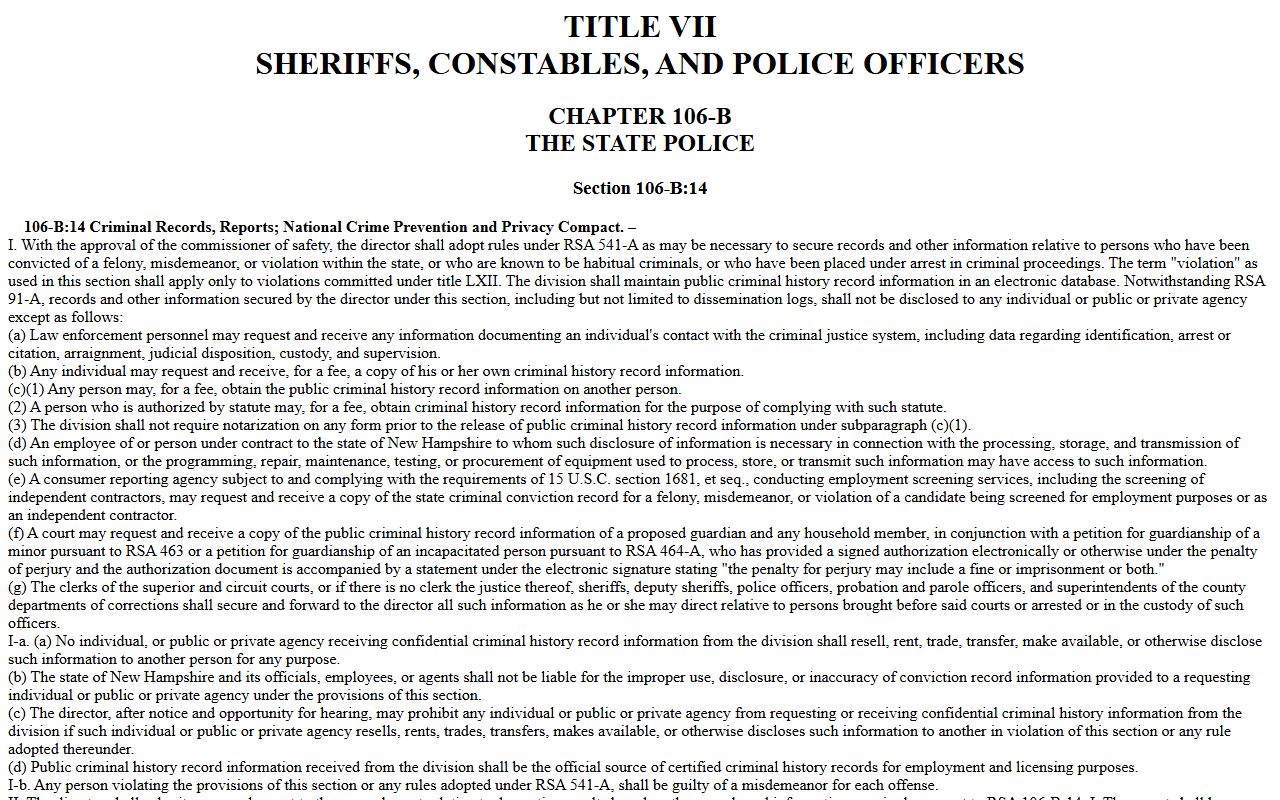
This statute is the reason a private user cannot pull a full criminal history with warrant detail from the state. Background checks go through set channels with consent rules.
Bench Warrants After Missed Court Dates
Most warrants seen in Hillsborough County courts are bench warrants. A bench warrant is signed by the judge from the bench, often the same day a person fails to appear. Common triggers are a missed arraignment, a missed pretrial conference, a missed probation review, or contempt for not paying a court-ordered amount.
New Hampshire bail and warrant practice is shaped by RSA 597, which sets the framework for bail and the conditions a judge may impose when a person is brought back to court on a warrant. A bench warrant in a misdemeanor case is not minor. It can lead to an arrest at a traffic stop, at work, or at home. The right move is to call the clerk and ask if the warrant can be cleared by motion and a new hearing.
Note: A bench warrant in a civil case, such as a contempt order in a divorce or a family matter, may have different consequences from one in a new criminal case.
Search Warrants and Sealed Filings
Search warrants are a different animal from arrest or bench warrants. A judge signs a search warrant based on a sworn affidavit from a police officer. The affidavit lays out the facts that support probable cause to search a place or seize property. While the investigation is open, the affidavit and the warrant itself can stay sealed. The point is to protect informants, ongoing leads, and the safety of officers carrying out the search.
After a search has been done and any related charges have been filed, much of the file may open. A defense lawyer can move to unseal the affidavit and review it for legal challenges. Without an active case, a member of the public often cannot inspect a search-warrant affidavit. Reporters and researchers sometimes file motions to access older sealed files, but the burden is on the person seeking access.
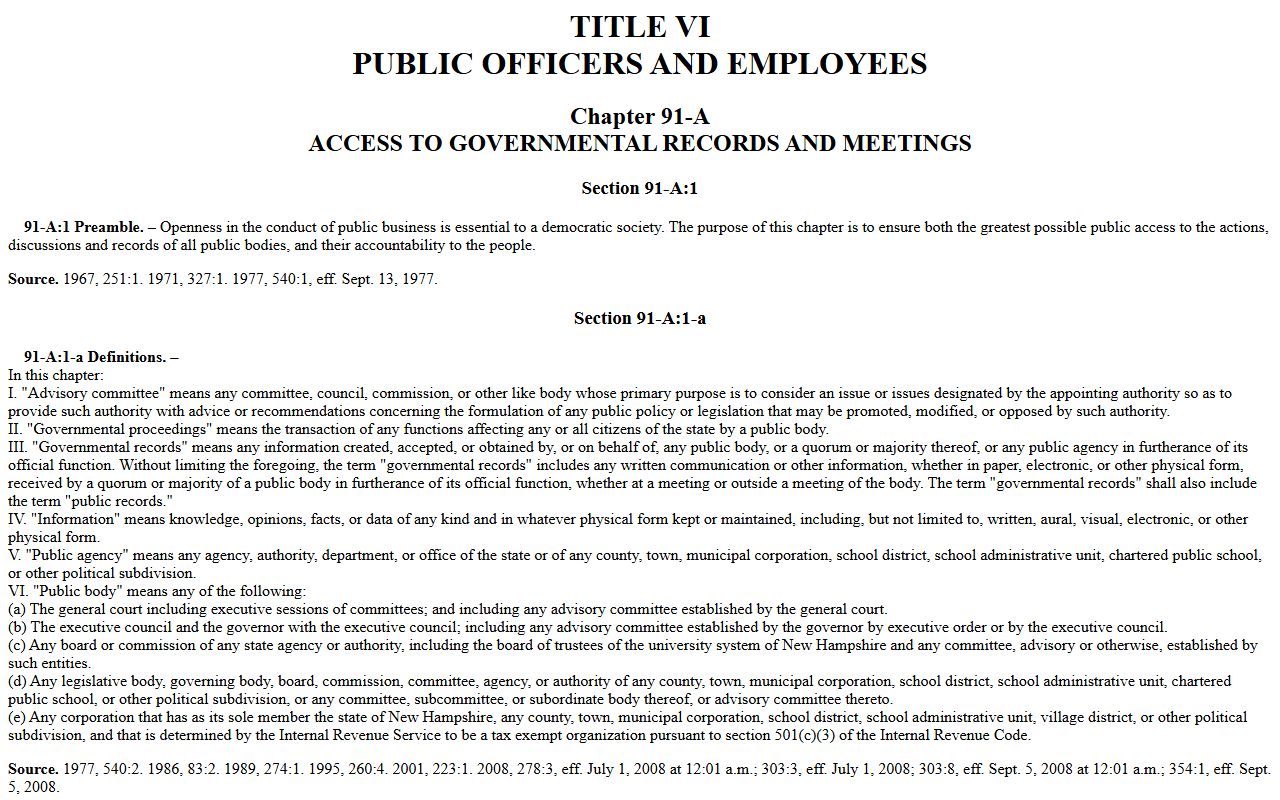
New Hampshire's open-records law, the Right-to-Know Law, sits at RSA 91-A. It guides public access to records held by government bodies, with court records carved out under separate court rules. The image below shows the statute page.
For a deeper path on open-records requests outside the courts, see the public records page on this site.
How to Resolve an Outstanding Hillsborough County Warrant
A warrant does not go away on its own. Time makes things worse. The seven steps below match the path most defense lawyers walk a client through after a warrant is confirmed. Each step is short, but each one matters. Skipping any of them can lead to an unplanned arrest or a higher bail.
- Do not ignore court notices, missed hearing letters, or contact from police. A returned envelope or a voicemail can be the only warning before a warrant is served.
- Use the NH Case Access Portal to pull up the related case and read the docket entries.
- Call the clerk of the issuing court. Ask whether the warrant is active and what is needed to recall it.
- Ask whether the warrant can be cleared by filing a motion, scheduling a hearing, posting bail, or appearing in court on a set date.
- Talk with a defense lawyer before going to the courthouse if arrest is likely. Free help may be available through 603 Legal Aid or the New Hampshire Public Defender when a person qualifies.
- Bring photo ID and any proof of compliance or payment that relates to the warrant, such as a fine receipt or a completion certificate.
- After the warrant is recalled, confirm with the clerk that both the court and the police agency have updated their files. Keep the recall order on hand.
Important: Talk to a New Hampshire defense attorney through 603 Legal Aid or the NH Public Defender before turning yourself in on a warrant.
Paying an old fine online does not always clear a warrant. The court must enter a recall order, and the police agency must update its records. A printed receipt is not a substitute for a clean database entry. A person stopped on an unupdated warrant can still spend a night in jail. Confirm the update with a follow-up call to the clerk a few days after payment.
Restricted Warrants
Not all warrants are public. State law and court rules block access to several common types. Knowing which warrants are restricted can save hours of searching the wrong system.
- Juvenile warrants. Juvenile delinquency cases fall under RSA 169-B, which keeps most juvenile filings confidential. A juvenile warrant is not in the public docket.
- Sealed warrants. A judge may seal a warrant during an active investigation or when a victim's safety is at risk.
- Federal warrants. Federal warrants are not in any state or county system. The U.S. Marshals Service handles federal fugitive matters through the U.S. Marshals District of New Hampshire.
- Domestic violence and protective-order warrants. Some entries are restricted to protect the victim or witness.
- Out-of-state warrants. A warrant from another state may show up on a National Crime Information Center hit, but the underlying details stay with the issuing state.
Note: A federal inmate or a person held on a federal warrant can sometimes be located through the Federal Bureau of Prisons inmate locator, though pretrial holds may not appear until charges are filed.
Public Record Search
Sponsored Results