
What Hillsborough County City and Town Clerks Do
New Hampshire does not run a county clerk who holds all the records for the whole county. Instead, each city and town has its own clerk. For Hillsborough County, marriage licenses and certified vital records are a local matter. The clerk in Manchester, Nashua, or any other town issues a marriage license and holds the certified copies of birth, death, marriage, and divorce records tied to that place.
The city or town clerk is a vital-record custodian. The role is set by state vital-record law, RSA 5-C. Under that chapter the clerk takes marriage-license applications, records the returned license, and issues certified copies to people who qualify. The same office often handles voter registration and dog licenses, but the draw for most record seekers is marriage and vital records.
One point trips up a lot of people. The city or town clerk is not the court clerk. A divorce case file, a civil suit, or a probate matter sits with the courts. The town clerk holds the certified vital-record side. Both can touch the same event, but they are different offices with different rules.
Manchester and Nashua City Clerk Offices
Manchester and Nashua are the two largest cities in Hillsborough County, and both run busy city clerk offices. Many county residents use them for a marriage license or a certified copy. A couple is not locked into the office where they live. For exact addresses, phone numbers, and counter hours, check each official city clerk page, since those details change.
Manchester City Clerk
The Manchester City Clerk issues marriage licenses and handles certified vital records for the city. See the official Manchester City Clerk page for the current address, phone, hours, and fee details. Verify counter and appointment rules before you go.
Nashua City Clerk
The Nashua City Clerk runs the same core services for Nashua: marriage licenses and certified vital records. See the official Nashua City Clerk page for the current address, phone, hours, and fees. Confirm what to bring before your visit.
Smaller Hillsborough towns run their own clerk offices too. If you live in Milford, Hudson, or Merrimack, your town clerk handles the same marriage and vital-record work on a smaller scale.
Below is the Manchester clerk section, which lists the office's services. For the current page, see the Manchester City Clerk site.
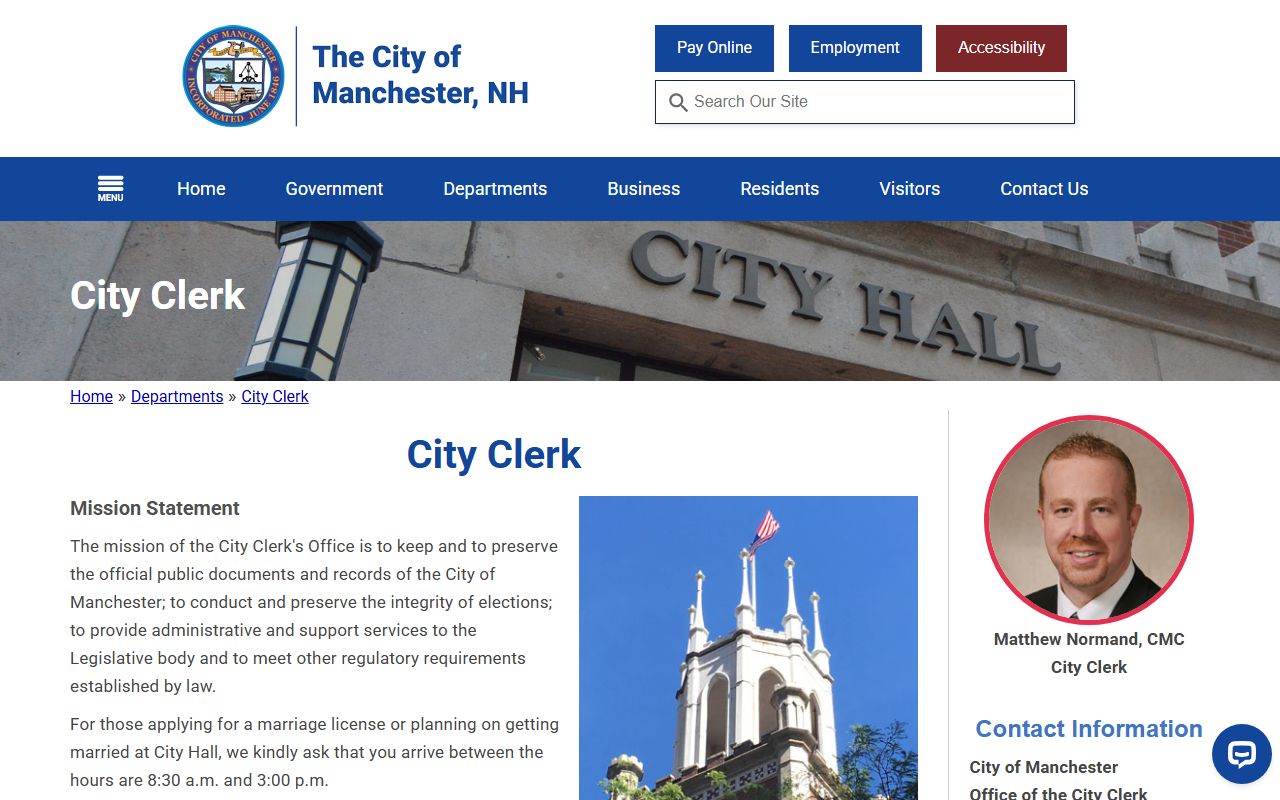
The Manchester page groups vital-record and clerk services in one place. The Nashua office, shown next, is set up in a similar way.
Here is the Nashua clerk section. The live page is the Nashua City Clerk site.

Both pages point you to the right counter for a marriage license versus a certified copy. Read the office hours first, since some services run by appointment.
Getting a Marriage License
A New Hampshire marriage license comes from a city or town clerk, not the court and not a county office. The steps are the same across the state, though each clerk controls small details. Plan to bring identification and any prior-marriage details with you.
- Choose any New Hampshire city or town clerk authorized to issue marriage licenses. A Manchester or Nashua office works for many Hillsborough County residents.
- Both applicants generally appear in person and give the required identification and personal information.
- If either person was divorced, widowed, or had a marriage annulled, provide the prior-marriage termination details the clerk asks for.
- Pay the city or town clerk's marriage-license fee. Verify the current amount with that office.
- The clerk issues the license. There is no blood test under modern state rules.
- Have the marriage solemnized by an authorized officiant within the license period.
- The officiant completes and returns the license so it can be recorded.
- Request certified copies from the clerk or the state vital-record system, subject to RSA 5-C eligibility.
The license and the certified copy are two different things. The license lets the marriage happen. The certified copy is the proof you get afterward, requested on its own.
Note: A certified copy is not always handed out at the ceremony. In many offices couples must request and pay for copies separately after the license is recorded.
Marriage License Application Fields
The marriage-license application asks for the information that ends up on the marriage record itself. Both applicants fill out their own side. Most fields are required. A few only apply if a prior marriage ended.
| Field | Type | Required | Notes |
|---|---|---|---|
| Applicant 1 full legal name | Text | Yes | As shown on the ID. |
| Applicant 2 full legal name | Text | Yes | As shown on the ID. |
| Date of birth / age | Date / number | Yes | Used for eligibility and the vital record. |
| Place of birth | Text | Yes | City, state, country. |
| Residence address | Text | Yes | Current home address. |
| Parent names / birthplaces | Text | Yes | Vital-record information. |
| Prior marriage status | Checkbox / text | Conditional | Divorce, death, or annulment details if it applies. |
| Identification | Document | Yes | Government ID; the local clerk sets the exact proof. |
| Signature | Signature | Yes | Both applicants sign. |
| Fee payment | Payment | Yes | Verify the current city or town fee. |
Fill the form in fully before you reach the counter if the clerk allows it. A missing parent name or birthplace can slow things down.
Certified Vital Records in Hillsborough County
Certified vital records cover birth, death, marriage, and divorce. In Hillsborough County these come through a city or town clerk or through the state Division of Vital Records Administration. The whole system runs under RSA 5-C. That law sets who can get a record, what counts as proof, and how the certified copy is issued.
Access is tied to your relationship to the record. You cannot pull anyone's certified birth or marriage record on demand. The law limits certified copies to the person named and to people with a direct and tangible interest, like a spouse, parent, child, or legal representative. The clerk checks eligibility first. Older historical records may open up more over time.
For statewide rules, the New Hampshire Division of Vital Records Administration is the central office. The full vital-record statute is RSA 5-C. A divorce vital-record abstract falls under this same system, which is separate from the divorce case file held by the court.
Note: Eligibility for a certified vital record depends on your relationship to the person named, so be ready to show how you qualify under RSA 5-C.
Vital Record Fees and Identification
Each office sets its own counter rules within the state framework, so check fees and ID needs before you go. The notes below hold true across Hillsborough County offices.
Fee and ID notes:
- No single statewide marriage-license fee was confirmed from official sources, so use the current city or town clerk fee page rather than an old number.
- Bring a government photo ID for both the marriage-license application and a certified-copy request.
- If you were divorced, widowed, or had a marriage annulled, the clerk may want the date, place, and supporting details.
- A blood test is not a modern New Hampshire marriage-license requirement.
- Certified copies are usually requested and paid for on their own, not bundled with the license.
The fee at one office may differ from the next town over. That is normal in a city and town clerk system. Confirm the amount with the office you plan to use.
City/Town Clerk vs Court Clerk
This is the split that confuses people most, especially anyone from a state with one big county clerk office. In New Hampshire the work is divided. The city or town clerk holds vital and marriage records. The court clerk holds court case files. You go to the right one based on what you need.
| City / Town Clerk | Court Clerk | |
|---|---|---|
| Holds | Marriage licenses, certified vital records | Court case files and dockets |
| Record types | Birth, death, marriage, divorce abstracts | Civil, criminal, family, probate cases |
| Governed by | RSA 5-C vital-record law | Judicial Branch rules and access law |
| Office level | City or town, not a county clerk | State court location |
| Use for | Getting married, certified copies | Tracking or copying a court case |
So if you want a marriage license or a certified birth or death copy, the city or town clerk is your office. If you need a divorce case file, a docket, or any court filing, you want the court side. See the Clerk of Court page for how court records work in Hillsborough County.
Divorce Records vs Divorce Certificates
Divorce is the clearest case of the two systems touching one event. There are two different records, and they live in two different places. Knowing which you need saves a wasted trip.
The divorce case file is a court record. Divorce cases are handled by the New Hampshire Circuit Court Family Division. The file holds the petition, financial affidavits, parenting plans, motions, temporary orders, and the final decree. Much of that material is sensitive, and parts can be restricted, redacted, or sealed. You get the case file through the court clerk, not the town clerk.
The divorce certificate, or abstract, is a vital record. It is a short, certified record that the divorce happened, and it comes through the vital-record system under RSA 5-C. It is not the full case file. People often need the certificate for a name change, remarriage, or benefits. For how divorce filings work, see the marriage and divorce records page.
Other Records City and Town Clerks Keep
Vital and marriage records are the main draw, but the city or town clerk office handles other local work too. The clerk often runs voter registration, issues dog licenses, and keeps certain local administrative records. These are local government functions, not court records.
What a clerk holds varies from town to town. If you are after a record that is not a vital or marriage record, ask the office what it keeps. For broader open-government requests outside the courts, the Right-to-Know path under RSA 91-A is the usual route. See the public records page for that.