
Hillsborough County Probate Records and the Circuit Court Probate Division
Probate in New Hampshire is not run by a county probate office. The state handles it through the New Hampshire Circuit Court Probate Division. Many people expect a county clerk to hold estate files, the way other states do it. New Hampshire centralizes the work inside its unified court system instead. The Probate Division resource page sits on the Judicial Branch site at courts.nh.gov/resources/probate-division.
The statutory base is RSA 547. That chapter sets out Probate Division authority over estates, wills, guardianships, conservatorships, trusts, and name changes. So a single division handles a wide spread of matters. Some are open to the public. Some are not. The split depends on the case type and the privacy rules that apply.
For Hillsborough County, probate filings run through Circuit Court locations that serve the county. The official file stays with the court clerk. Online tools give a window into part of the record, but the clerk holds the full set. That is why a search can turn up an estate yet still send you to the clerk for certified copies or older files.
How to Search Hillsborough County Probate Records
The public entry point is the New Hampshire Case Access Portal. It carries non-confidential Circuit Court case types. Estate cases and name-change cases are listed among the types you can search online. Guardianships are not. The portal excludes guardianships from current e-filed case access, so a guardianship file will not show the way an estate file does. Conservatorships and trusts can carry tighter limits too.
A case-number search gives the cleanest hit. If you have no number, a party or estate name works, though common names in Manchester or Nashua may return many results. Narrow by case type, court location, and filing date when the list grows long. The table below shows the fields a probate search uses.
| Field | Type | What It Does |
|---|---|---|
| Case Number | Text | The most exact way in. Copy it from a notice or filed paper. |
| Estate / Party Name | Text | A decedent, petitioner, fiduciary, ward, or trust name. |
| Case Type | Filter | Estate, name change, trust, guardianship, conservatorship; public access varies by type. |
| Court Location | Filter | The Hillsborough Probate or Circuit location holding the case. |
| Filing Date Range | Date | Limits results to a window of time. |
| Search | Button | Runs the query. |
If a case does not appear, it may be a type the portal excludes, a file older than the e-filing rollout, or a sealed matter. The next step is the clerk. The clerk handles certified copies, older paper files, sealed files, and access questions that the portal cannot answer.
What Probate Records Show
A probate record builds over the life of a case. Early entries open the matter and name the parties. Later entries log hearings, orders, and the steps a fiduciary takes. The list below covers the fields a public probate record typically holds.
- Case number. The court's unique tag for the matter.
- Case type. Estate, name change, trust, guardianship, or conservatorship.
- Court location. The Hillsborough Circuit or Probate location of record.
- Names where public. Decedent, ward, or petitioner.
- Fiduciary name where public. The executor, administrator, or personal representative.
- Filing date. When the case opened.
- Docket events. Motions, notices, continuances, and other dated entries.
- Orders and hearings. The court's rulings and any set hearing dates.
- Bond, inventory, and accounting references. Listed where the filing is public.
Some material does not show at all. Confidential medical and financial details may be sealed or left out, even in a case that is otherwise open. Treat an online search as a starting point, not the whole story.
Note: An online docket can post an order before the clerk finishes formal processing, so do not rely on a screen entry until the clerk has issued notice.
How Probate Works in Hillsborough County
Probate moves through a set order of steps. The exact path depends on whether there was a will, how big the estate is, and whether anyone objects. The basic flow stays the same across most estates in the county.
- Find out whether the person who died left a will.
- File the proper estate petition or application with the Probate Division.
- Provide the death certificate and the required fiduciary information.
- Ask the court to appoint an executor or administrator if one is needed.
- Give notice to heirs, beneficiaries, and creditors as the rules require.
- Inventory the estate's assets.
- Pay debts, taxes, and expenses.
- Resolve any disputes or claims that come up.
- Account for the estate and distribute the remaining property.
- Close the estate with the court.
Each step can leave a record. The petition, the appointment order, the inventory, the creditor notices, and the closing order all post as filings. That is what a searcher sees as docket events. A short estate may show a few entries. A long or contested one may show dozens.
Estates and Wills
An estate file is the core of most probate work. It can hold the petition or application, a reference to the death certificate, the will and any codicils, the appointment order, a fiduciary bond or waiver, the inventory, creditor notices, accountings, receipts, a distribution plan, and the closing order. Read in order, those filings tell the story of how the estate was settled.
Even a routine estate can take months. Creditors get a window to file claims. Real estate may need to sell. Taxes must be sorted, title issues resolved, and beneficiaries given notice. So a file that looks simple may still run a long time on the docket.
A will may be filed for probate after a death. While the person is alive, access and safekeeping rules depend on court and statutory procedures that should be verified with the Probate Division. Once a will is part of an open estate file, it may be public, though related medical or financial papers can still be held back.
Contested estates run a different course. A will contest, an undue influence claim, a capacity challenge, a petition to remove a fiduciary, or an objection to an accounting can all turn a quiet file into a fight. The docket grows with each motion and order.
Guardianships and Conservatorships
Guardianship and conservatorship files get special treatment. Both involve a person who may not be able to make some decisions alone. So the records hold sensitive material, and public access is narrower than for an ordinary estate. The Case Access Portal does not include guardianships in its e-filed case access set at all.
An adult guardianship starts with allegations of incapacity. It can lead to a real restriction of a person's rights. The file may include medical evaluations, capacity reports, a guardian's plan, annual reports, and orders. None of that should be treated as a normal public document. A conservatorship is similar but focused on money. It handles property and financial management for someone who cannot manage their own affairs, and its file can hold inventories, accountings, bank and property information, a bond, and court orders.
Part of the reason these files stay closed traces to mental health confidentiality law. Involuntary admissions and related proceedings carry medical and privacy-sensitive material, and that shapes how guardianship records are handled. The statute pictured below sets the frame.
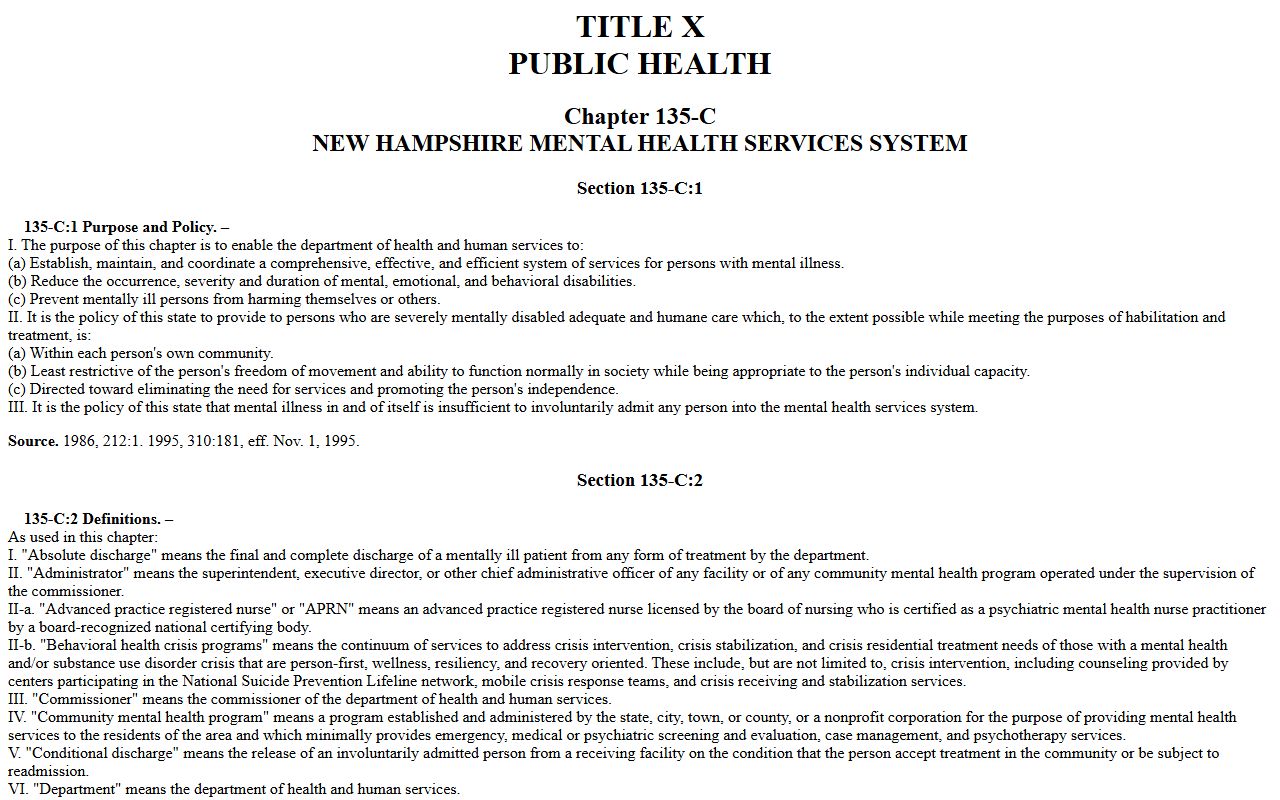
RSA 135-C governs mental health services and the confidentiality that comes with them. It is one reason a guardianship or related proceeding may not show online the way an estate does. If you need a guardianship or conservatorship record, contact the Probate Division clerk and expect to show why you are entitled to access.
Note: A guardian makes personal decisions for a protected person, while a conservator manages money and property; one case may name both roles or only one.
Trusts and Name Changes
Trust proceedings ask the court to step into a trust matter. A petition might ask the court to read a trust, appoint or remove a trustee, approve an accounting, instruct a fiduciary, or settle a dispute among beneficiaries. Trust documents often hold private family and financial information. Public access depends on how the matter was filed, whether anything was sealed, and what the court orders.
Name-change cases sit at the open end of the range. They are listed as non-confidential Circuit Court case types available in the portal. So a name change is one of the probate matters you can usually find online. Even so, a minor's case, a safety concern, or a sealed petition can still limit access.
A final name-change order matters beyond the court. People use it to update records at the DMV, Social Security, the passport office, and banks. Each agency sets its own proof rules, but a certified copy of the court's final order is the document they ask for.
Probate Fees and Certified Copies
Probate matters carry filing and copy costs, but a single statewide number is hard to pin down, and it changes. The current NH Judicial Branch fee schedule controls. Verify it with the Probate Division clerk before you file or order copies rather than relying on a figure quoted elsewhere. Fees can differ by case type and by the kind of document you request.
Certified copies are a common reason to contact the clerk. A bank may need a certified appointment order before it will open an estate account. A registry of deeds or a title company may need one before property can transfer. A plain printout from an online search is not a certified record. For anything that affects money or title, request the certified document from the Probate Division clerk.
Probate Terms Defined
Probate uses a set of words that repeat across files. Learn a few, and a docket reads faster. The list below covers the terms that come up most in Hillsborough County probate matters.
- Testator
- The person who made a will. The will speaks for the testator after death.
- Executor
- The person named in a will to carry out the estate. The court confirms the role.
- Administrator
- The person the court appoints to settle an estate when there is no will, a state often called intestate.
- Guardian
- A person appointed to make personal decisions for someone who cannot make them alone.
- Conservator
- A person appointed to manage the financial and property affairs of another.
- Fiduciary
- Anyone who must act in another's best interest, such as an executor, administrator, guardian, conservator, or trustee.
A fiduciary carries real legal duties and can be held personally liable for mishandling funds. That is one reason the court watches the role through bonds, inventories, and accountings.
Legal Help for Probate Matters
Many probate steps can be done without a lawyer, and the Judicial Branch posts self-help forms and guidance at courts.nh.gov/self-help. Common forms cover the estate petition, will filing, appointment of an administrator or executor, the inventory, the accounting, a fiduciary bond or waiver, and closing documents. Read the instructions for each form before you file.
People who cannot afford counsel can reach out to 603 Legal Aid for civil legal help and referrals. That can be a starting point when money is tight and the matter is not simple.
Some situations call for a lawyer no matter what. Real estate, firearms, business interests, out-of-state property, and contested heirs all raise issues that are easy to get wrong. Tax questions are another. Estates can touch federal estate tax, capital gains, Medicaid estate recovery, and transfer questions, and none of that should be settled from a web page. Talk to qualified counsel or a tax professional for those parts.