
How to Find Hillsborough County Arrest Records
An arrest record starts with the agency that made the arrest. In Hillsborough County, that may be a city or town police force, the county sheriff, or the New Hampshire State Police. The arresting agency holds the arrest report. The county jail holds the booking record once a person is taken in. There is no single public arrest blotter portal that lists every recent arrest in the county. So a search often means going to more than one office.
The Hillsborough County Department of Corrections runs the county jail and posts inmate rules through its inmate information page. That page explains custody handling, but it is not a full searchable roster of every booking. The Sheriff's Office handles warrants, transport, and civil process. For the arrest report on a specific case, the request goes to the police agency that made the arrest, under the state Right-to-Know Law.
- Find the arresting agency. Note the city or town police force, the sheriff, or the state police.
- Ask that agency for the arrest report under RSA 91-A. Some details may be held during an open case.
- Check the county jail inmate information for current custody status.
- For the court case tied to the arrest, use the state Case Access Portal by name or case number.
Each path returns a different slice. The police report covers the arrest. The jail record covers custody. The court file covers charges and outcome.
Booking and the Arrest Process in Hillsborough County
Booking is the formal step that opens a jail record. After an arrest, police may transport the person to the county jail or hold them at a police station first. The county jail, run by the Hillsborough County Department of Corrections, sits at 445 Willow Street in Manchester. That is the central detention point for county detainees, both pretrial and sentenced. Intake follows a set order, and each step creates data that may show up later.
- Arrest. Made by police, sheriff, state police, or another authorized agency.
- Transport. The person is moved to county jail or held at a police station, based on timing.
- Intake screening. Staff confirm identity, inventory property, and run a medical and mental-health check.
- Booking photo and prints. A mugshot and fingerprints are taken as part of intake.
- Bail or arraignment. Release terms are set under court rules and state bail law.
- Classification. Staff assign housing based on charges, safety, and health, not on guilt.
Custody can rest on more than one legal basis at once. A new arrest, a bench warrant, a parole hold, or a sentence can all hold a person at the same time. The Hillsborough County Sheriff's Office page links to the office that handles county law-enforcement duties.
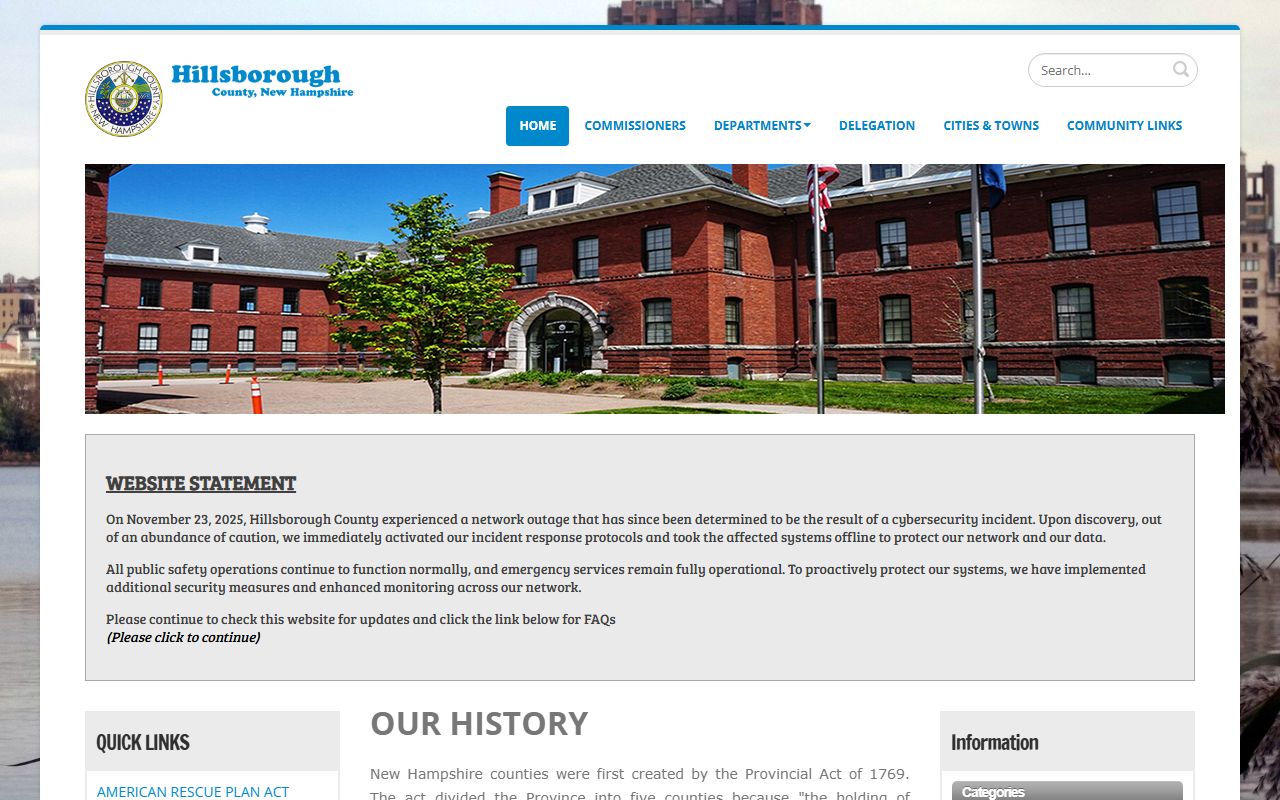
The Sheriff's Office page helps a reader reach the right office. Court dates and dispositions, though, are tracked by the court clerk, not the jail.
Hillsborough County Mugshots and Arrest Reports
A mugshot is the booking photo taken during jail intake. It belongs to the agency that booked the person. An arrest report is the officer's written account of the arrest. Both are arrest-stage records. They sit with law enforcement, not the court. The county does not run a public mugshot gallery in the official sources reviewed, so a reader should not assume every booking photo is posted online.
Arrest reports are governed by the state Right-to-Know Law. Many basic arrest facts are open. But access can be limited while a case is under active investigation. Police may hold parts of a report to protect an open case, a victim, or a witness. To get an arrest report, a reader contacts the police agency that made the arrest and frames the request under RSA 91-A.
Note: A booking photo or arrest report shows only the charge at arrest, which can differ from what a prosecutor later files in court.
Hillsborough County Arrest Record vs Criminal Court Record
An arrest record and a criminal court record are two different things with two homes. The arrest record is made by police or the sheriff at booking. The criminal court record begins later, when a prosecutor files charges and the court opens a case. One is a law-enforcement record. The other is a judicial record. The table below lays out the split.
| Arrest Record | Criminal Court Record | |
|---|---|---|
| What it is | A law-enforcement record of an arrest and booking | A court file of a charged criminal case |
| Custodian | Arresting police agency, sheriff, or county jail | Court clerk and the Judicial Branch |
| What it shows | Booking info, charge at arrest, mugshot, custody status | Pleadings, motions, hearings, disposition, sentence |
| Where to access | Police agency under RSA 91-A; county jail inmate info | Case Access Portal and the clerk of court |
For the full case history that follows an arrest, the court file is the right source. Charges, pleas, and the final outcome live there. See Hillsborough County court records for the path to full case files and certified copies.
Charges vs Convictions
A charge is not a conviction. An arrest and a charge are an accusation. They mean the state thinks there is enough cause to bring a case. A conviction is a finding of guilt, by plea or by verdict, after the case runs its course. Many arrests never end in a conviction. Charges can be dropped, dismissed, or end in a not-guilty result. Reading an arrest record as proof of guilt is a mistake.
| Charge | Conviction | |
|---|---|---|
| Stage | Accusation at or after arrest | Finding of guilt by plea or verdict |
| Burden of proof | Probable cause | Beyond a reasonable doubt |
| Meaning | The state alleges an offense | The court finds the offense proven |
| Can it change | Yes, may be dropped or amended | Final unless appealed or annulled |
The state court portal warns users not to treat a case search as a background check. Felony cases run through Superior Court. Misdemeanors and violations run through the Circuit Court District Division.
Hillsborough County Criminal History vs a Court Case Search
A court case search is not an official criminal history. The two come from different systems. A case search pulls public court files for one court or name. An official criminal history is a state-held record of arrests and dispositions across agencies. In New Hampshire, criminal history record information is governed by RSA 106-B:14 and handled by the State Police. That is the official process. Scraping court portal results is not.
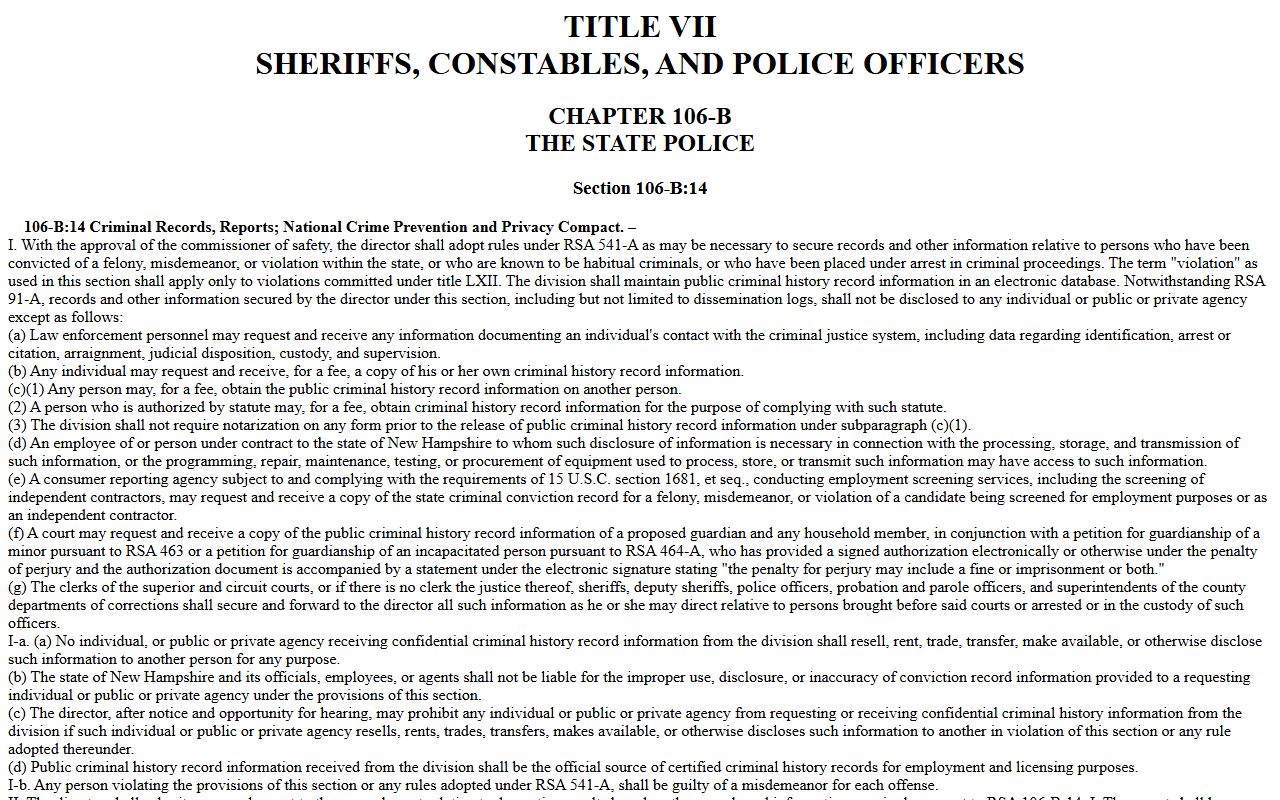
The statute above sets how the State Police release criminal history record information. Because of it, a name search on the court portal can miss arrests handled in other courts, sealed matters, or records held by other agencies. Anyone who needs a true background check for a job, a lease, or a license should use the official criminal-record process. A court search is a fine way to track one case.
Sealed vs Expunged: Annulment in New Hampshire
New Hampshire does not use the word "expungement" for criminal records. The state term is annulment. Many people search for "sealed" or "expunged" records out of habit, but the New Hampshire process is annulment under RSA 651:5. The table below sorts the common terms.
| Sealed | Annulment (NH term) | |
|---|---|---|
| What happens | Record hidden from normal public view | Eligible record annulled and treated differently |
| NH usage | Used by court order in some cases | The main path for clearing criminal records |
| Law enforcement | May still have limited access | Some court and law-enforcement exceptions remain |
| Eligibility | Set by statute or court order | Depends on offense, outcome, time, and conduct |
Annulment is not the same as destroying every government record. Eligibility turns on the offense type, the case result, completion of the sentence, payment of fines, and waiting periods. A person files a petition with the right court, and the prosecutor may weigh in. Forms and self-help material are posted at courts.nh.gov/self-help. Cases with felonies or license effects often need a lawyer.
Juvenile and Restricted Arrest Records
Not every arrest record is open. Juvenile matters are restricted by statute. Delinquency cases for minors fall under RSA 169-B and are not searched like adult cases. Access is usually limited to parties, counsel, agencies, and people the court allows. A reader should not expect to find a juvenile arrest in a public portal.
Other arrest-related records carry their own limits. Sealed cases may show little or nothing on a docket. Arrest reports tied to an active investigation can be held in part. Records with a victim's protected address, a minor's name, or medical data are often redacted. Annulled records change in how they appear for most public purposes. These rules protect privacy and safety, and they apply even to a curious reader.
Note: Juvenile arrest and delinquency records are confidential by law, so they are not available through ordinary public arrest or court searches.
Searching Hillsborough County Criminal Court Cases
Once an arrest leads to charges, the case moves to court, and the record opens to a public search. The state runs one online entry point for this. The Case Access Portal carries non-confidential Superior Court criminal cases and a set of Circuit Court District Division cases. A case-number search is the most exact. A name search in Manchester or Nashua can return many people, so narrow by case type.
The court file shows what the arrest record cannot: the charges as filed, the arraignment, motions, hearing dates, the disposition, and any sentence. For the full path on case files, certified copies, and clerk contacts, see court records. To track events in a live case, the court dockets page explains how to read docket entries line by line. A few key terms repeat across these records.
- Arraignment
- The first criminal appearance, where charges and bail or release status are set.
- Indictment
- A felony charging document issued after grand-jury action.
- Bail
- Conditions or money set to secure a defendant's return to court.
- Recognizance
- Release on a promise and set conditions rather than full cash bail.
- Disposition
- The outcome of a case or of one charge, such as dismissed, guilty, or not guilty.
County Attorney and Defense Counsel
Two offices shape the path of a criminal case after arrest. The prosecutor brings the case for the state. The defense represents the accused. In New Hampshire the local prosecutor is the County Attorney. The Hillsborough County Attorney prosecutes felony cases and other matters set by state law, works with police, and supports victims and witnesses. The County Attorney represents the State, not a private victim, so it does not control whether charges are dropped.
A person who cannot afford a lawyer can ask the court for appointed counsel. Indigent defense runs through the state system under RSA 604-A and the New Hampshire Public Defender. The request is made to the court in an active case, often with a financial form. For broader help, 603 Legal Aid offers referral and civil legal support to those who qualify.
Important: Hillsborough County Court Records is not a consumer reporting agency under the FCRA, and arrest data here may not be used for employment, tenant, credit, or insurance decisions.