
Public Records in Hillsborough County and the Right-to-Know Law
New Hampshire's open-government law is the Right-to-Know Law, found at RSA 91-A. It sets the default rule for government records. Government records are presumed open to the public. An office may withhold a record only when a clear exemption applies. The same law also opens most public meetings.
For Hillsborough County public records, this means a budget table, a delegation packet, a sheriff policy, or jail population figures are usually open on request. The requester does not have to explain why. The burden sits with the agency to justify a denial. Copy fees may apply.
RSA 91-A also gives a path to court. A person who is wrongly denied can ask a superior court to order release. Still, the law is not the whole map. Court files and certain sensitive records sit under separate rules. Read the full text of RSA 91-A here.
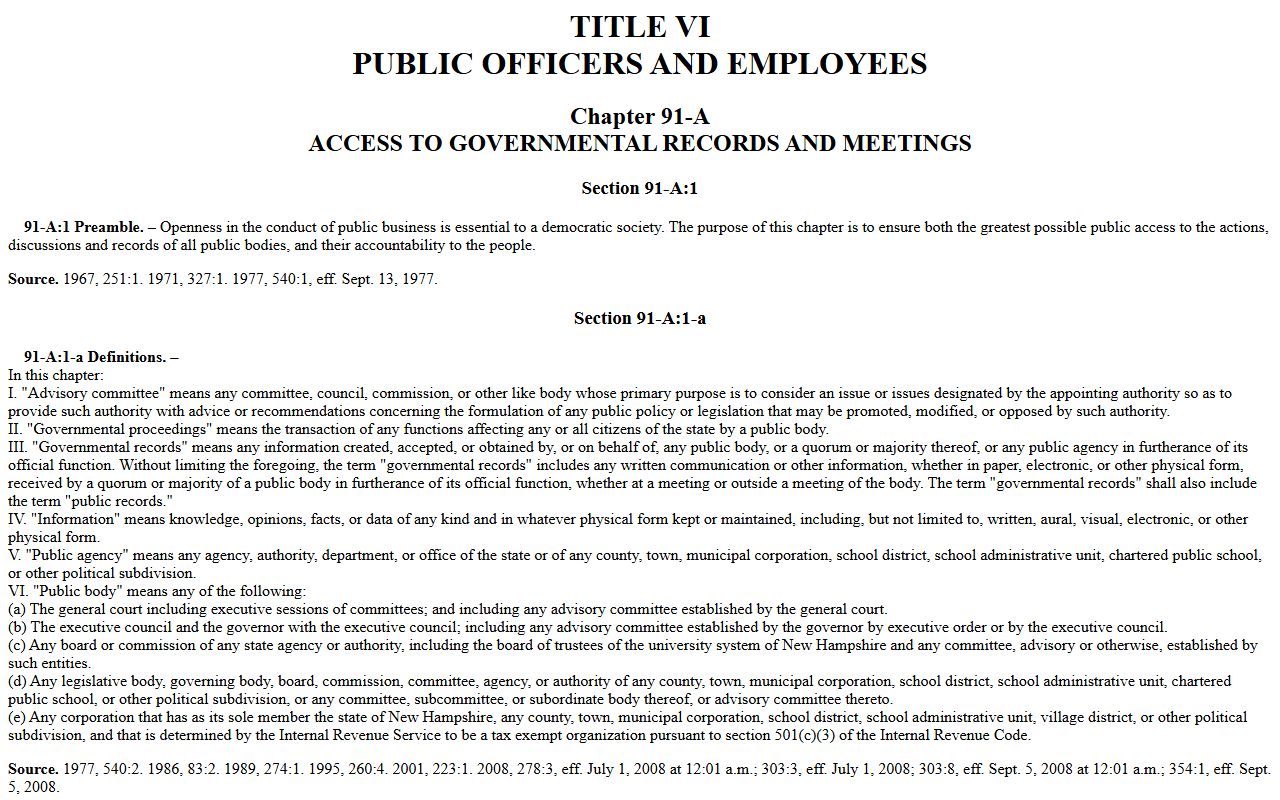
The statute page lays out the request rules, the exemptions, and the remedies. It tells you what an agency can and cannot keep back from a public records request.
Three Systems for Hillsborough County Records
It helps to picture public access as three overlapping systems, not one. Each has its own custodian, its own law, and its own way in. A single problem can cross all three. An arrest may produce a police record, a jail booking, a court case, and a criminal-history entry. Each piece has a different home.
| System | What It Covers | Where to Go |
|---|---|---|
| RSA 91-A government records | County budget, delegation minutes, sheriff policies, jail data, town and city files | The office that holds the record, asked in writing under RSA 91-A |
| Court records | Civil, criminal, family, probate case files and dockets | The New Hampshire Judicial Branch, the Case Access Portal, and the court clerk |
| Special-statute records | Criminal history, vital records, juvenile, adoption, mental health | The state agency or local clerk named in each separate statute |
The common mistake is to treat all three as one. People send a Right-to-Know request to a court for a case file, or ask a town clerk for a background check. The request goes nowhere because the office is not the right custodian. Match the record to the system first. A denial from one office does not mean the record is closed everywhere.
Why Court Records Are Different
Court records do not run on RSA 91-A. New Hampshire manages court files through a unified Judicial Branch, not a county clerk. Access follows court rules, common-law public-access principles, and case-specific confidentiality laws. So a Right-to-Know request is not the right tool for a court case file, and the law is not a complete substitute for court-record access.
The public entry point for court files is the New Hampshire Judicial Branch Case Access Portal. It carries limited, non-confidential case information from the state trial courts. The portal is free, but it is not the official court record and should not be used for background checks. The official file stays with the clerk.
So the path is different. You search the portal first. For full files, certified copies, or older records, you go to the clerk. Some case types, such as guardianships and involuntary admissions, are kept out of public online view. For the full path, see the court records, clerk of court, and court dockets pages.
How to File a Public Records Request
A Right-to-Know request is simpler than people fear. You do not need a lawyer or a special form. You do need the right office and a clear request. The steps below walk through a clean RSA 91-A request for Hillsborough County public records.
- Find the right custodian. Decide which office holds the record. County records go to the county office. Town and city files go to the local clerk or department.
- Put the request in writing. A short letter or email works. Cite RSA 91-A so the office knows the legal basis.
- Be specific. Name the records, the date range, and the format you want. Vague requests slow everything down.
- Let the agency review for exemptions. The office checks whether any rule blocks part of the record.
- Get the response. The agency produces the records, points you to where they are public, or explains a denial.
- Expect copy fees. Production or copying costs may apply under the agency's fee schedule.
- Appeal if wrongly denied. You can ask a superior court to order release.
Keep a copy of what you send and the date. That matters if a dispute lands in court. A narrow request usually gets a faster answer than a broad one.
Records Request Form Fields
Many Hillsborough County offices accept a plain letter, but some use their own request form. The fields are short and similar across offices. The table below lists the fields a records request usually asks for. The exact form varies by agency.
| Field | What It Shows |
|---|---|
| Requester Name | The name of the person asking for the records. |
| Contact Information | Mailing address, email, or phone so the office can reply. |
| Description of Records | A clear statement of the records sought, as specific as you can make it. |
| Date Range | The time period the records should cover. |
| Format Requested | Paper copy, electronic file, or inspection in person. |
| Delivery Method | Pickup, mail, or email delivery of the produced records. |
| Signature / Date | Your sign-off and the date of the request. |
A few offices add a line for the purpose of the request. Under RSA 91-A you do not have to give a reason to inspect government records, but some offices ask anyway.
County Records You Can Request
Hillsborough County government keeps a range of administrative records that fall under the Right-to-Know Law. These are the day-to-day files of how the county runs. Most are open on request unless an exemption applies. A written request is often the cleanest route to current data.
- County budget records and line-item spending tables.
- Delegation meeting minutes and packets. The county delegation page lists the body that sets the budget.
- Jail population and capacity data from the county Department of Corrections.
- Sheriff administrative policies and procedure manuals, subject to security exemptions.
- Contracts, audits, and personnel policy documents held by county offices.
The county does not publish a simple live jail population count in the sources reviewed. For current figures on capacity, daily population, and staffing, the county budget and delegation materials are the best public source. When those fall short, a Right-to-Know request to county government is the next step. See the jail population page for what the county publishes. The county homepage sits at hcnh.org.
Note: Jail records can carry medical, security, personnel, and inmate-privacy exemptions, so an office may release some county data while holding back sensitive parts.
Criminal History and Vital Records Are Separate
Two common requests do not run on RSA 91-A at all. Criminal history and vital records each sit under their own law and custodian. A Right-to-Know request for these often goes nowhere.
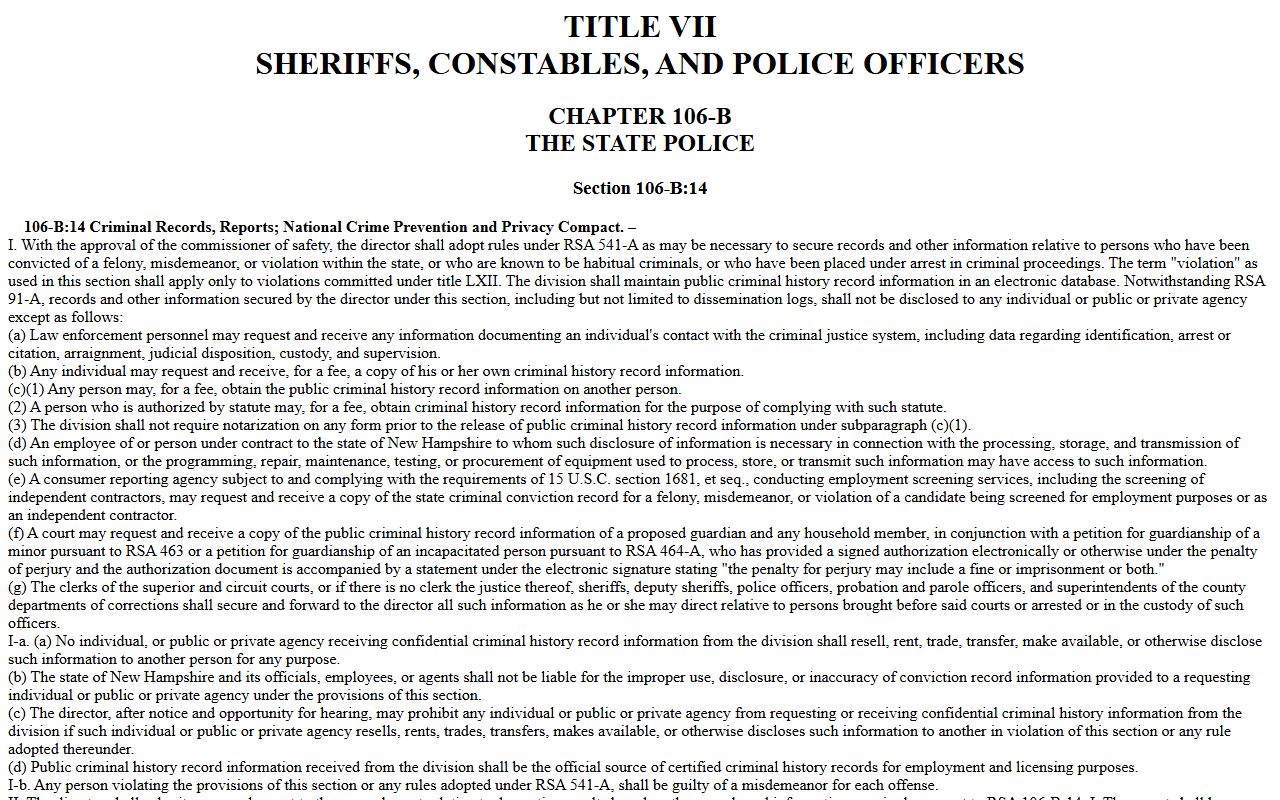
Criminal history record information is controlled by RSA 106-B:14. The New Hampshire State Police handle the dissemination of this data, not a county office and not a Right-to-Know request. That is why a court-case name search is not the same as an official background check. A portal hit is not a certified report.
Vital records follow RSA 5-C. Birth, death, marriage, and divorce abstracts are handled by city and town clerks and the state vital-records office, not the courts and not RSA 91-A. Access depends on the record type, its age, and your relationship to the person. A certified divorce abstract is separate from the court's case file. See the marriage and divorce records and city and town clerk pages.
Confidential and Exempt Records
Not every record is open, even under a strong Right-to-Know Law. Some are confidential by statute. Others may be redacted to protect privacy. An agency must point to a real exemption to withhold.
Juvenile delinquency files under RSA 169-B are restricted to authorized people and court orders. Adoption records under RSA 170-B are confidential and usually need a court order. Mental health proceedings under RSA 135-C include private medical material and are kept out of the public online court view. Sealed cases, protected addresses, and personal identifiers are also withheld or redacted.
For government records under RSA 91-A, exemptions still apply. Personnel files, some investigative material, and certain security details can be held back. When an exemption covers only part of a record, the office should release the rest. The law weighs the public interest in disclosure against the privacy harm of release.
Fees and Response Timelines
Fees under the Right-to-Know Law generally cover copying or records production, not a charge for the office to review your request. The exact amount depends on the agency's own fee schedule. The notes below set out how fees and timing work without quoting a price.
Note: Copy and production fees are set by each agency's current schedule. The clerk or office controls the amount, so always ask the office for its rate before you assume a cost. Do not rely on fee figures from other states.
On timing, RSA 91-A sets out how an agency must respond. The office should produce the records, point you to where they are public, or give a written denial with its reason within the law's timeframe. If it needs more time, it should say so. Flat silence is not an answer the law allows.
For court-record copies, the fee schedule is different again. The court clerk and the current Judicial Branch schedule control there. Vital-record copies follow the city or town clerk and the state schedule under RSA 5-C. Match the fee rule to the record's system.
Appeals and Denials
A denial is not always the end. Under RSA 91-A, an agency that withholds a record must justify it with a real legal reason. The office cannot refuse without basis. If you think a denial was wrong, the law gives you a path.
The forum is the superior court. A person who is unlawfully denied access can file there and ask a judge to order release. The court reviews whether the claimed exemption fits. Because the law puts the burden on the agency, the office has to defend its choice, not the requester.
Court records run differently. A dispute over access to a court file is handled within the Judicial Branch and its rules, not as an RSA 91-A action against an agency. So before you appeal, confirm which system holds it.
Public Record Search
Sponsored Results